werk, bauen & wohnen Issue 6–2026 «Re-use»
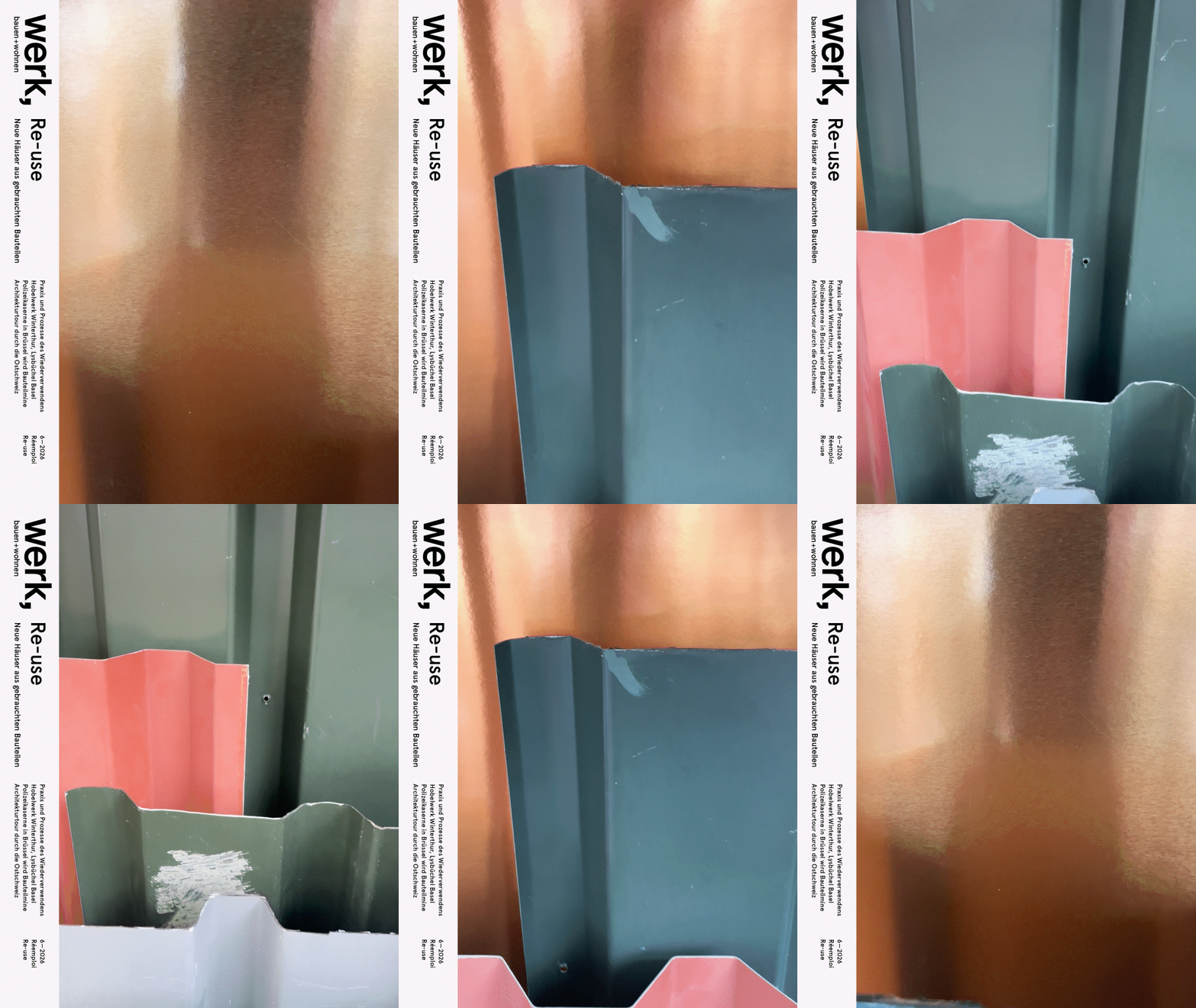
Re-use next level
Today no architecture school worth its salt would omit to offer a hands-on design course based on re-use. Experimental buildings at a scale of 1:1 are attractive and suitable for a teaching -experiment, as a different understanding of material cycles and jointing techniques can be trained using them. And training is needed, for re-use makes very new demands on designs. They must be oriented on the availability of material — design by availability.
The building of the future is a hybrid of old and new. So that it will itself be able to serve as a “mine” it should be possible to take it apart without damaging it: design for disassembly.
The first pilot projects, such as the addition of a storey to K118 in Winterthur by Baubüro in situ (wbw 5 – 2021, p. 10 – 11), were undertaken a number of years ago and they inspired the world of architecture and far beyond it.1 Recently a film about Barbara Buser, the founder of in-situ and pioneer of re-use was released in cinemas. In this movie she forcefully reminds us about the waste problem that plagues our consumer so-ciety. The only way we will be able to deal with this is if we re-use buildings as a whole or in parts.
The first large re-use projects have recently been realised; a number are still being worked on. We visited apartment buildings in Basel and in Winterthur where we encountered two very different design approaches to re-use. In addition, we asked around in the re-use community: what are the experiences in planning and building with re-use? What does the whole thing cost? Is the financial cost proportionate to the eco-logical benefit? There can be no doubt that planning processes are being turned completely -upside down. During the research work for this issue we discovered that the capital of re-use is Brussels, where offices like Rotor or BC Architects have been at the forefront of building with re-used building components for years. Here we can already observe a certain step that still lies ahead for Swiss cities: thinking of an entire site as a store of building elements. This is how building with re-used components can reach the next level on the scale: re-use next level.
— Jasmin Kunst, Roland Züger