werk, bauen + wohnen 11–2026 «Living in the office»
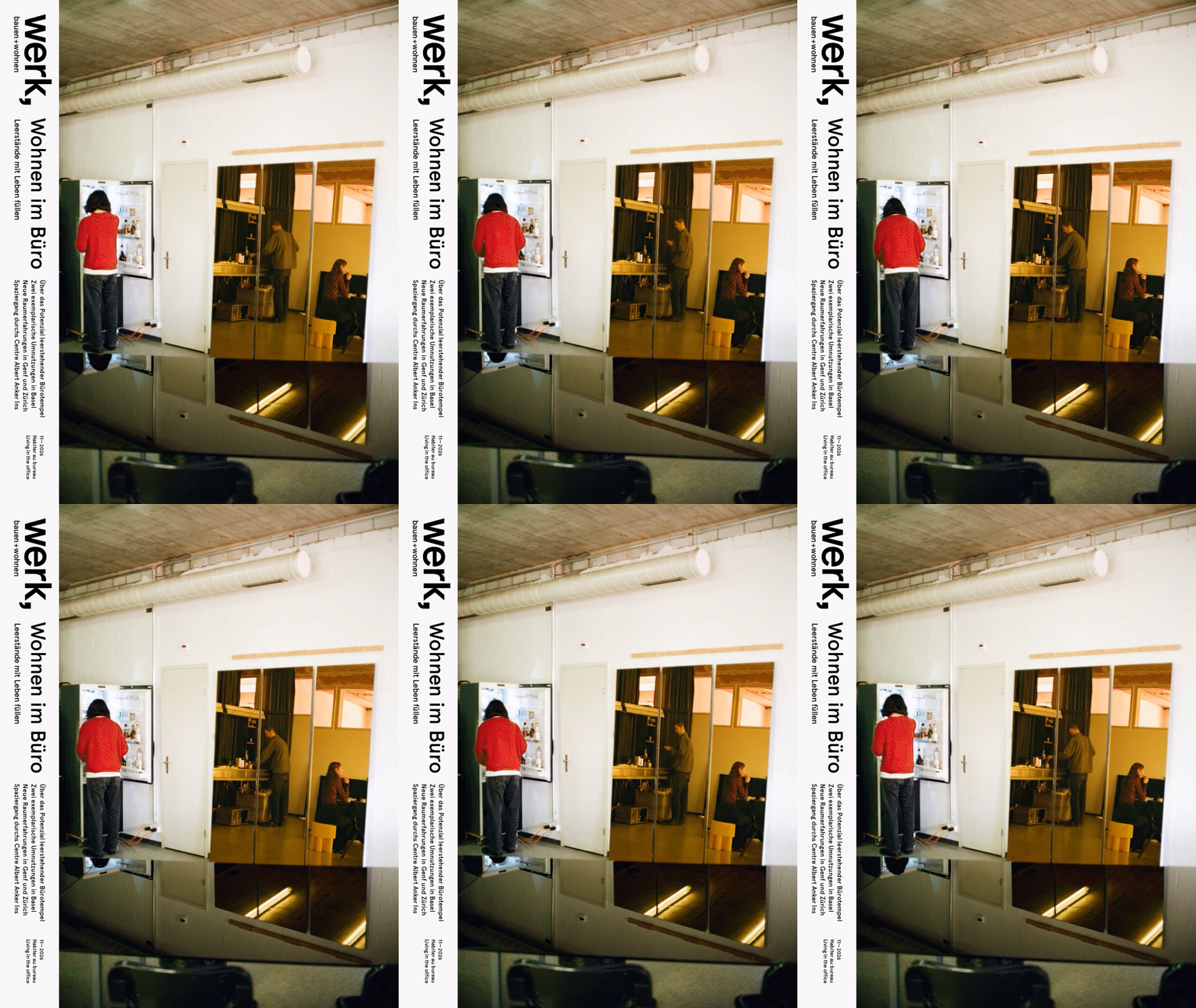
Office-Home
In Switzerland there are currently many vacant office spaces. According to statistics compiled by UBS, in 2025 the vacancy rate was eight -percent. In certain peripheral areas it is even as high as 30 percent. Taking a look at the real -estate market reveals a clear tendency: in com-parison to the previous year, the office vacancy rate in conurbations has increased by nine -percent — and this figure is growing.
The world of work is changing — not just since the Covid-19 pandemic. Hybrid working, -co-working spaces and desk-sharing schemes have long since become standard and if one can believe the prognoses AI will probably reduce the need for office workspaces even further. But to assume consequently that businesses can no longer afford to build themselves new office blocks would be mistaken, see HdM’s Hortus, Mailand-Strasse or the Rocheturm 3. But that is a different story.
At the same time there is a widespread shortage of affordable housing. Throughout the country only one percent of apartments are -vacant, in Zurich just 0.1 per cent. And prices are rising. There is an obvious simple solution: why not live in offices? When I was a student, I had several acquaintances who rented an -office, which, without further ado, and by ex-ploiting a grey area in planning legislation, they themselves converted into a flat share.
Applying this approach on a bigger scale and in accordance with the norms, presents planners with several challenges. These include, for instance, the depth of office buildings, the limited amount of circulation space (apartments are smaller than offices) which makes it necessary to construct additional staircases and circulation cores or leads to long corridors. Adding bathrooms and kitchens requires new service shafts, while structural considerations also play a role: party walls and new elements mean greater loads. In addition, there is the -demand for private or communally used outdoor spaces and, naturally, thought must be -given to building regulation themes such as noise, a window to floor area ratio that ensures sufficient daylight, and the question of zoning.
Despite these difficulties, several successful transformations of office space have been completed recently, as illustrated by the examples in this issue. Further projects are underway. As is so often the case, they remind us that conversions achieve surprising qualities which new buildings cannot offer. It is precisely where the demands of regulations and standards seem so restrictive that an unsuspected creativity is revealed. — Jasmin Kunst